A difference between a controller indication and a reference thermometer can come from different sensing locations, not only from calibration offset. Establish the comparison boundary and thermal conditions before applying an input correction.
- Compare sensors at a controlled, documented thermal location.
- Separate electrical input-chain error from real spatial temperature differences.
- Validate any justified correction across the required operating interval.
Why can two valid temperature readings disagree?
Two sensors can correctly report different temperatures when they occupy different locations. Immersion, surface contact, radiation, airflow and nearby heat sources can also affect what each sensor experiences. A comparison is meaningful only when those conditions are appropriate to the question.
For a TX4-H temperature-controller project, first define whether the objective is input-chain accuracy or process-temperature uniformity. A control sensor near a heater and a reference near the workpiece do not necessarily measure the same physical quantity, even when both display degrees Celsius.
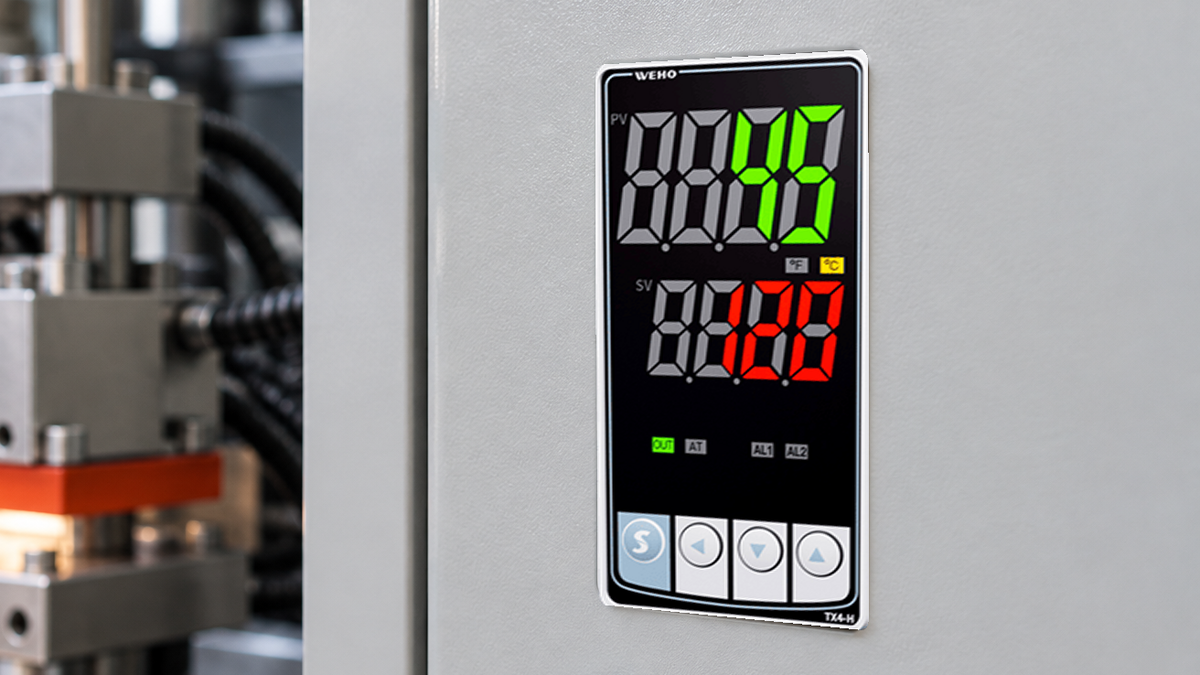
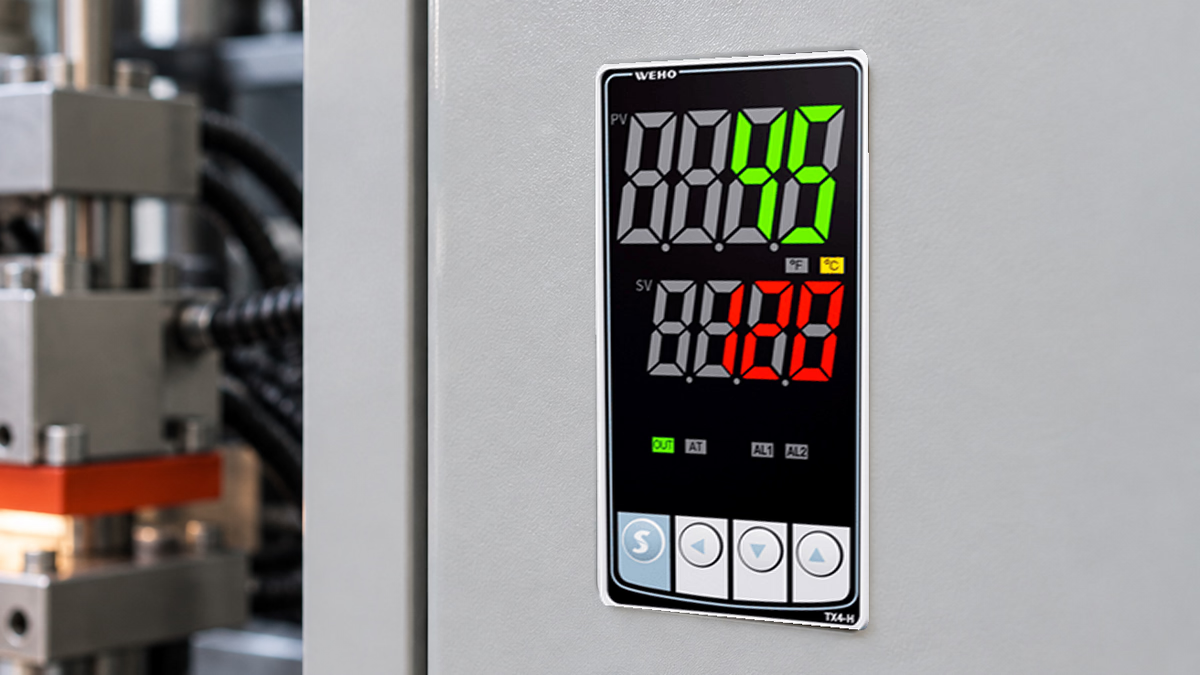
The application scene establishes the panel context. Its retained display values are not a calibration record or proof of a process gradient. The following numbers are explicit hypothetical observations used to illustrate how a correction can be misapplied.
The decision matters during OEM commissioning and supplier review. Entering an offset because two displays differ can make the control sensor's local indication wrong while concealing the actual temperature distribution. A corrected-looking screen may therefore reduce, rather than improve, understanding of the process.
How can a location difference be mistaken for offset?
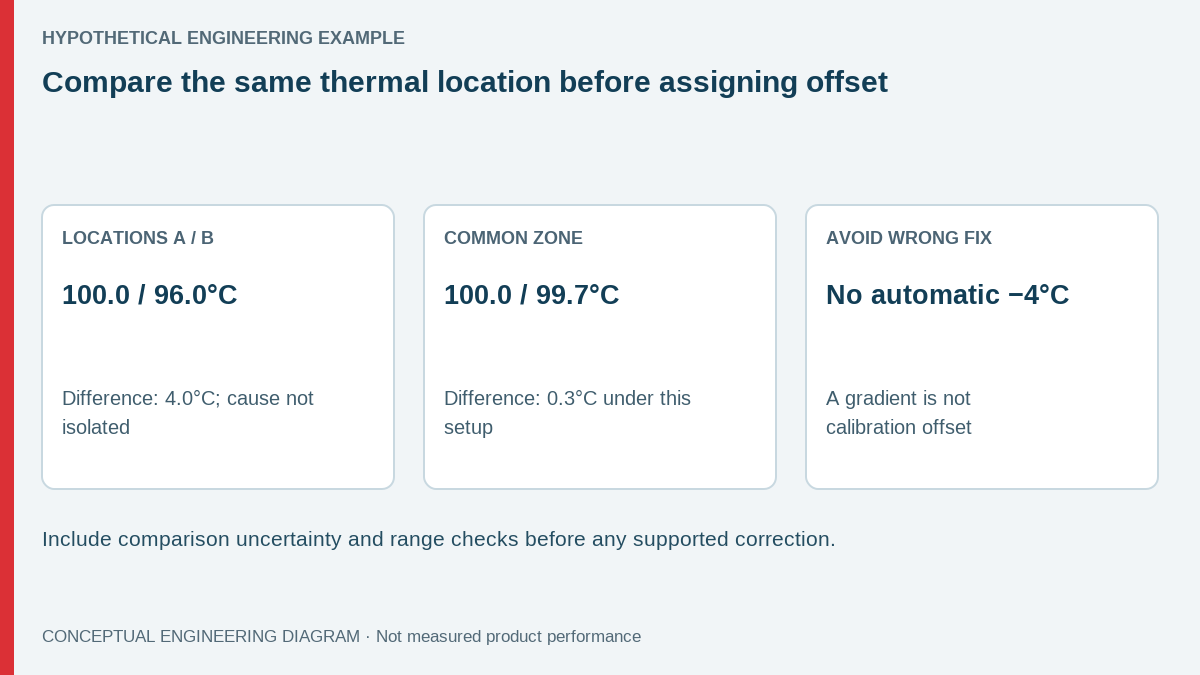
Consider a hypothetical test with a controller probe at location A and a reference at location B. The controller displays 100.0°C while the reference displays 96.0°C. The −4.0°C difference is an observation between two locations; it does not yet establish a −4.0°C input-chain error.
Suppose a controlled comparison then places both sensing elements appropriately in the same stable reference zone, and their indications become 100.0°C and 99.7°C. The observed difference is now −0.3°C under that arrangement. Measurement uncertainty and setup effects still need consideration before assigning a correction.
If an operator had applied −4.0°C to the controller after the first observation, its corrected indication in the second arrangement would be 96.0°C rather than approximately 100°C. The original location difference would have been embedded in the input chain as an inappropriate adjustment.
These examples do not specify TX4-H accuracy or the correction required for a real unit. They demonstrate why the physical measurement boundary must be established before editing a parameter. A valid correction must be supported by the actual comparison and the applicable device documentation.
| Hypothetical arrangement | Controller | Reference | Supported interpretation |
|---|---|---|---|
| Different process locations A and B | 100.0°C | 96.0°C | 4.0°C indication difference; cause not isolated |
| Controlled common reference zone | 100.0°C | 99.7°C | 0.3°C comparison difference under this setup |
| Unjustified −4.0°C correction applied | 96.0°C corrected | 99.7°C | Original spatial difference has been misapplied |
| Actual acceptance | Use documented points | Include uncertainty | Apply a predetermined decision rule |
What should the calibration boundary include?
State whether the comparison covers the controller alone, the controller plus sensor, or the installed measurement chain. An electrical simulator can isolate some input behavior but does not establish probe placement, immersion or heat transfer. A thermal comparison can include more of the chain but introduces its own setup requirements.
Use a reference with suitable uncertainty and operating conditions for the required decision. A calibration certificate describes specified conditions and results; it does not automatically include every error in a field comparison. Stability, uniformity, immersion and repeatability belong in the actual uncertainty assessment.
Fluke's temperature-probe guidance explains why sensing-element location and immersion matter. Record the reference's location relative to the sensing element, not merely “next to the machine.” A small physical separation can matter where gradients are steep. A photograph can help identify locations, but an unscaled image is not a substitute for the relevant setup dimensions and conditions.
For the controller setting itself, use the official TX4 manual. It describes input correction, but that capability does not justify applying a correction without evidence. Verify applicability to the supplied version and retain the original value before changing it.
How should a useful comparison sequence be designed?
Begin by checking input type, units, wiring and relevant controller settings. A wrong sensor configuration or connection can create an error that should be corrected at its cause rather than compensated with an offset. Avoid changing several settings at once before preserving the initial observations.
- Define the measurement-chain boundary and required operating interval.
- Establish an appropriate stable reference and sensing arrangement.
- Compare at selected points with documented stabilization criteria.
- Evaluate differences and uncertainty against the chosen acceptance rule.
- Apply only a justified, supported correction and verify the affected range again.
Qualified personnel should control heater operation, hot surfaces and other equipment consequences during the test. A substituted sensor or simulated temperature can change control output. Follow the site's procedure rather than assuming that a calibration activity automatically isolates the process.
Use both repeat observations and relevant temperature points. A constant offset may describe one error pattern, while a span-dependent difference suggests another. One correction value cannot be assumed to remove every nonlinear, sensor-related or installation-related error across an entire operating range.
When is a process gradient the actual problem?
A gradient is relevant when different parts of the process operate at different temperatures and that distribution affects the product requirement. In that case, the appropriate response may concern sensor location, thermal contact, heater arrangement, airflow or process loading. It is not automatically a controller calibration task.
Map the locations that matter to the process decision using a suitable method. Record loading, steady or transient state and environmental conditions. A gradient observed during warm-up may differ from the stabilized distribution, and an empty fixture may behave differently from a loaded one.
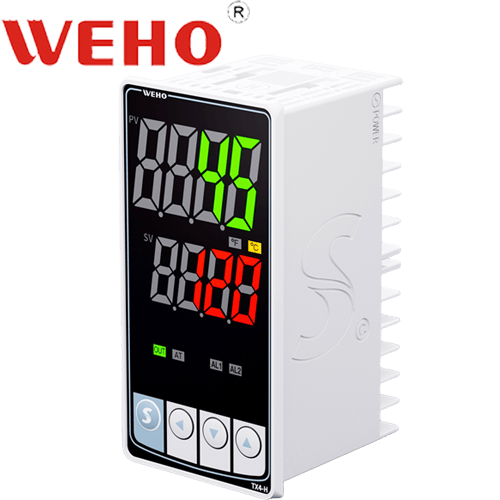
các TX4-H product information identifies the controller context for obtaining the applicable documentation. It does not establish that a single sensor represents every workpiece location or that a corrected display proves process uniformity.
A supplier report should separate local indication error from process distribution. Include the comparison setup, observed differences, original and revised correction values, and the decision rule. This makes it possible to discuss a real input-chain issue without asking the controller to compensate for an unrelated thermal layout problem.
Record whether the comparison sensor measures surface, fluid, air or an embedded location. Those methods can have different heat-transfer conditions even near the same nominal point. A surface probe pressed against an enclosure should not automatically be treated as a reference for an immersed control probe.
After a justified input correction, verify any process or alarm requirements affected by the changed indication. The necessary scope depends on the equipment design. A successful local comparison does not by itself establish that every threshold elsewhere in the machine remains appropriate.
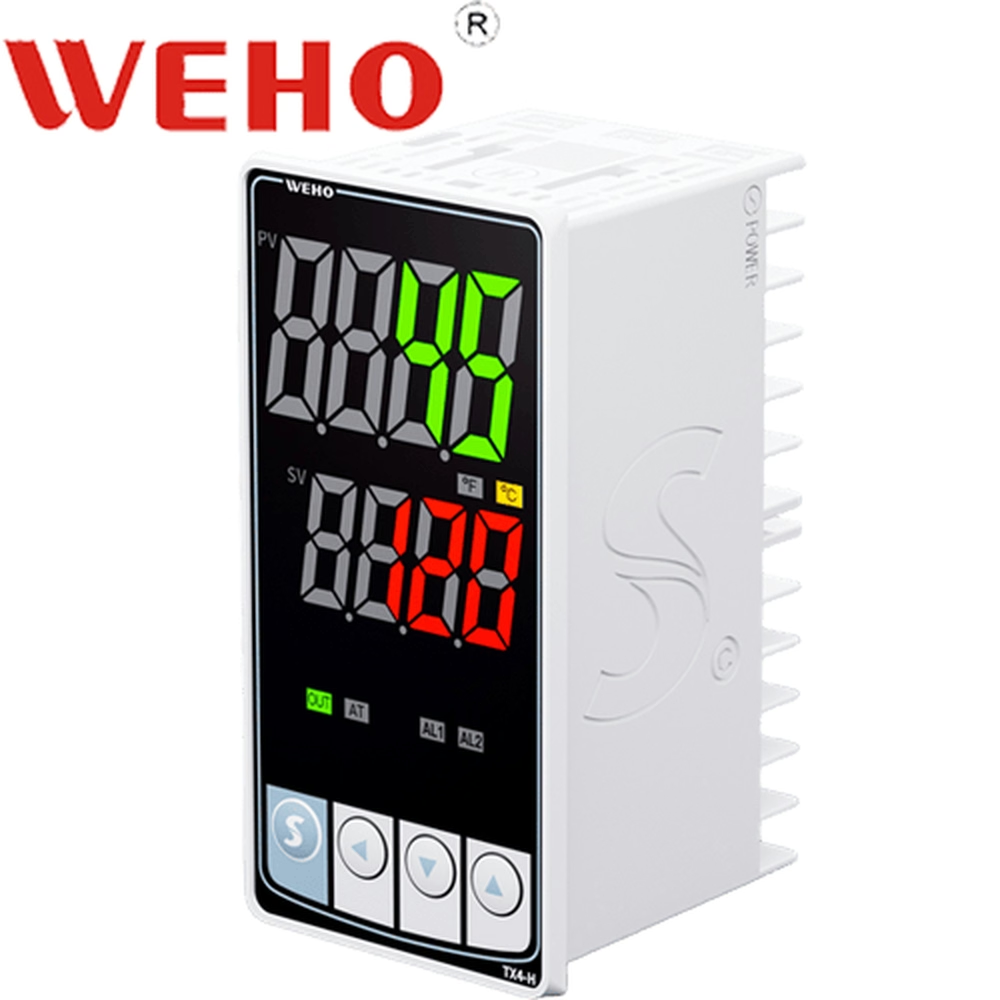
Prepare a TX4-H comparison review
Send WEHO the supplied variant, configured input, sensor arrangement and comparison table. Identify whether the reference and control sensor measured the same location under controlled conditions. Include the required temperature interval and uncertainty basis so any discussion of correction remains tied to evidence rather than a single unexplained display difference.
Frequently asked questions
Is every difference from a reference thermometer a controller error?
No. Location, sensor contact, immersion, reference uncertainty and actual process gradients can contribute. Establish the comparison boundary before assigning the difference to one device.
Can a single offset correct every temperature point?
Only if the evidence supports that model over the required interval. A span-dependent or nonlinear difference may require a different investigation; a convenient single-point match is insufficient.
Does an electrical simulator prove process uniformity?
No. It can support a defined electrical input check. Temperature distribution, probe placement and workpiece conditions need appropriate thermal evidence from the actual process.
Should the old correction value be preserved?
Yes. Retain the original configuration and the evidence for any change in the internal record. That allows the responsible engineer to understand and reverse an unjustified adjustment when necessary.