Compare the battery’s required terminal charging voltage with the exact charger variant’s usable output range, including distribution drop and control tolerances. A shared“24 V” label is not a compatibility decision.
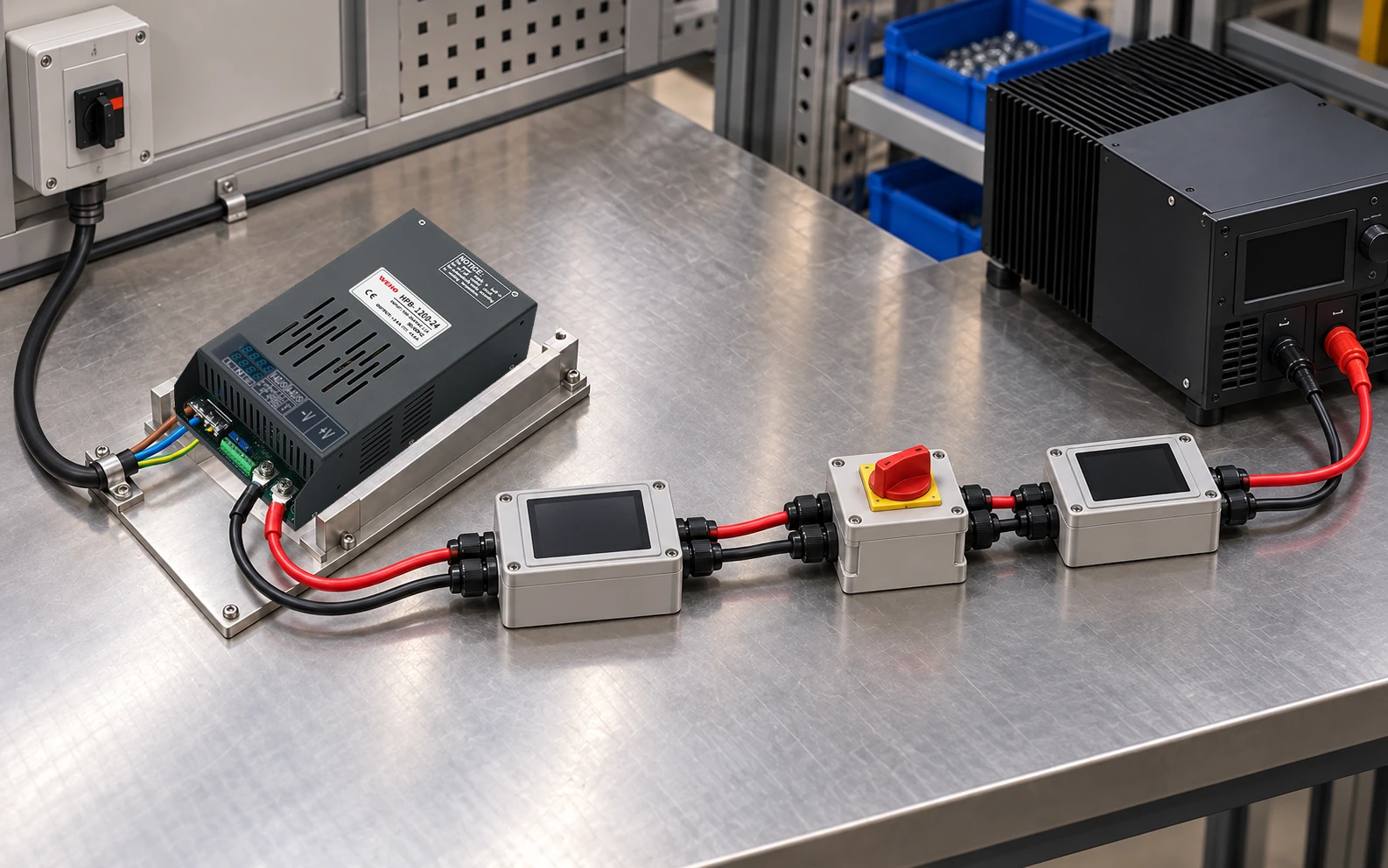
IL WEHO HPB-1200-24 product information illustrates why this check matters. Its table lists a 0–26.4 V output adjustment range for the 24 V column, while the family marketing text mentions higher charging voltages including 27.6 V and 29.2 V. Those statements do not establish that the photographed 24 V unit can provide those higher values.
Start from the exact battery charge requirement
Record chemistry, series-cell count, the approved charging procedure and the battery manufacturer’s voltage requirements. Keep maximum allowable voltage separate from the normal controlled target. A protection threshold is not automatically the correct charge setpoint.
Where an approved pack requirement is derived from a per-cell value, multiply by the actual series count and retain the source. Do not apply a cell value from another chemistry or assume the pack’s BMS uses the same setting.
A battery’s temperature conditions, allowed current and termination requirements also matter. This article isolates voltage headroom as an early screen; passing it would not establish a complete charge algorithm or battery-system approval.
Calculate the voltage required at the charger boundary
For an illustrative pack whose approved target is 3.55 V per cell across eight series cells, required battery-terminal voltage is8×3.55=28.4 V. If the approved charging route drops 0.20 V at the chosen current, the assumed charger-terminal requirement becomes 28.6 V before any further specified control allowance.
These hypothetical inputs are not a general lithium setting or an instruction for an unidentified battery. The purpose is to identify whether the available output range can even cover the stated task.
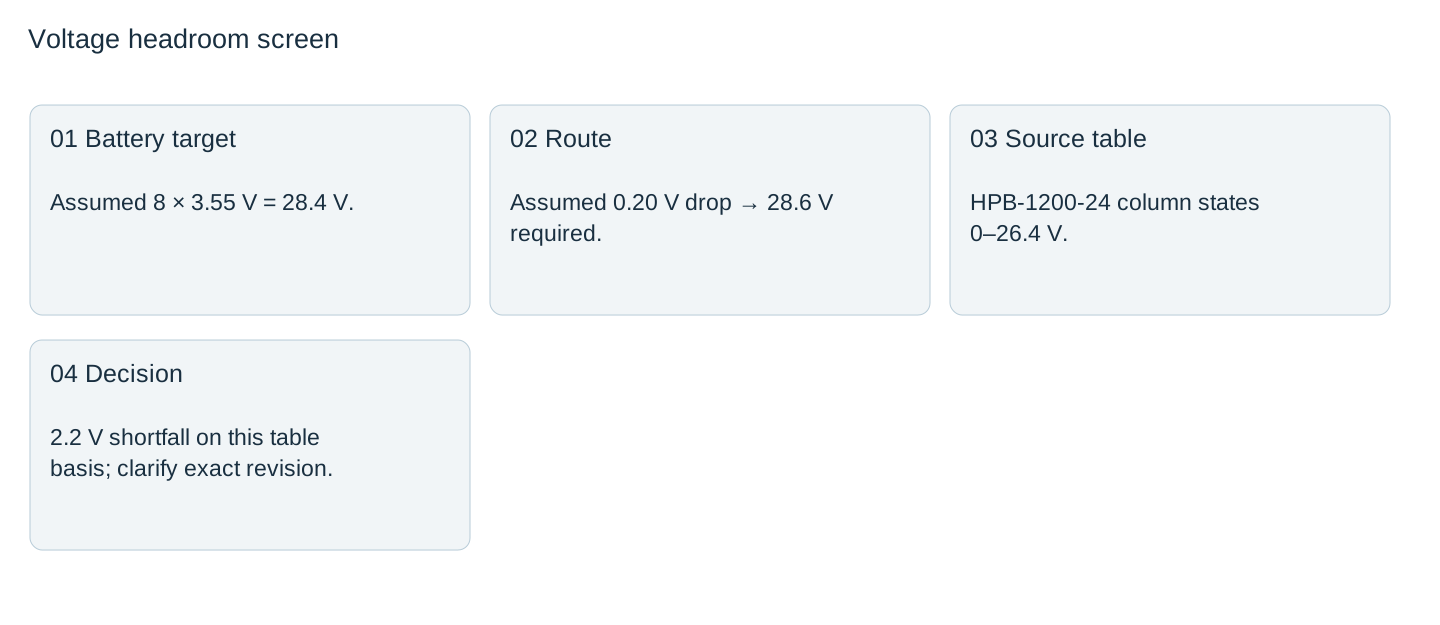

Against a 26.4 V table ceiling, that assumed 28.6 V requirement has a 2.2 V shortfall. A higher current rating cannot make up the missing voltage, and a larger family watt number does not change the selected variant’s range.
Keep the table, photograph and marketing statement distinct
The official photograph identifies HPB-1200-24 and 24 V/50 A. The product table’s corresponding column gives 24 V, 50 A and 0–26.4 V output adjustment. Those references establish the displayed identity and the published table entry; they do not resolve the higher family charging-voltage language.
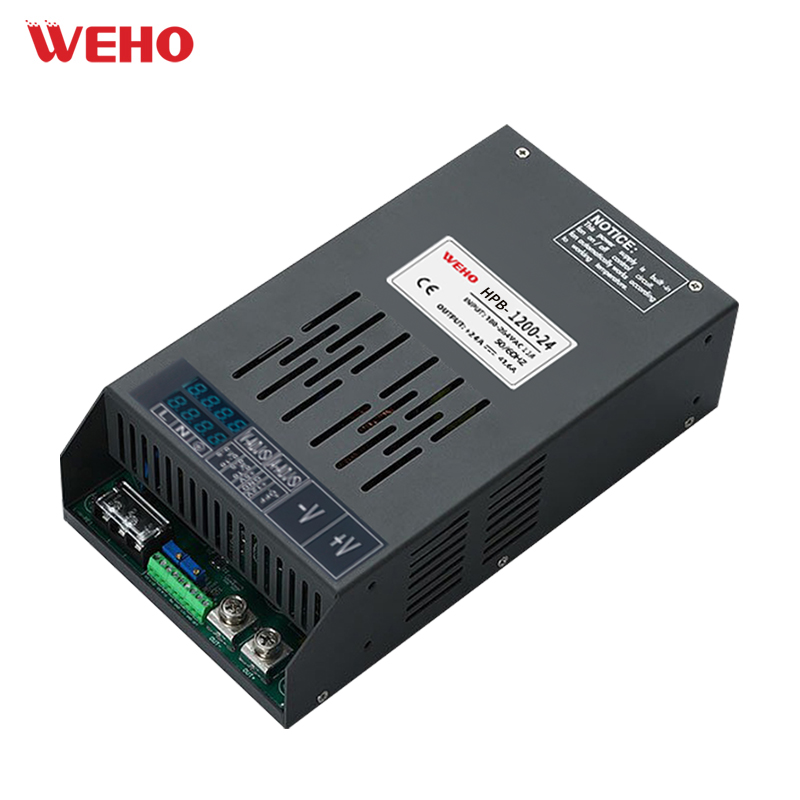
Request a controlled specification for the exact offered revision and an explanation of the relevant range. Do not silently select the larger marketing value or rewrite the product label to make the example fit.
Until the discrepancy is resolved, this source set cannot approve HPB-1200-24 for the hypothetical 28.6 V task. Another variant may have a different range, but it requires its own complete review and must not be presented as an automatic substitute.
Check the allowed current and power at the intended voltage
After a documented variant covers the voltage target, check its permitted current and power over that operating range. Separate a voltage-adjustment range from a constant-current operating range and from a continuous power envelope. Their upper numbers do not necessarily occur together.
Use the actual charge-current demand and applicable derating to define the evaluation point. Do not multiply independent maxima from unrelated rows and treat the product as approved there.
The broader industrial battery-charger selection guide covers chemistry and system commissioning. This voltage worksheet supplies the narrower first-stage rejection or clarification decision before those later checks consume time.
Close the screen with an explicit decision
Mark the result as range available, range insufficient, or source clarification required. Attach the exact table/revision, battery requirement and assumed/measured route drop. Do not turn an unresolved range into a provisional compatibility promise in the quotation.
Once an applicable range is confirmed, the responsible team must verify actual battery-terminal control under the approved charging sequence. Do not modify the unit beyond its documented range or adjust it experimentally against a connected battery to discover a maximum.
Reopen the record after a series-count, charge-target, route-current or charger-variant change. The useful outcome is a traceable voltage comparison that can reject an unsuitable candidate early, without relying on nominal 24 V matching.
Resolve the exact output range before selecting a charger
Send WEHO the battery’s controlled charge requirement, series count, current, lead-drop basis and the HPB-1200-24 table discrepancy. Request the offered revision’s confirmed output envelope before proceeding.
Battery-to-charger voltage headroom screen
| Required battery V | Route drop / allowance | Required charger V | Documented available range | Available / shortfall / clarification |
|---|---|---|---|---|
Blank project worksheet. Enter verified project data; example calculations above are not measurements.