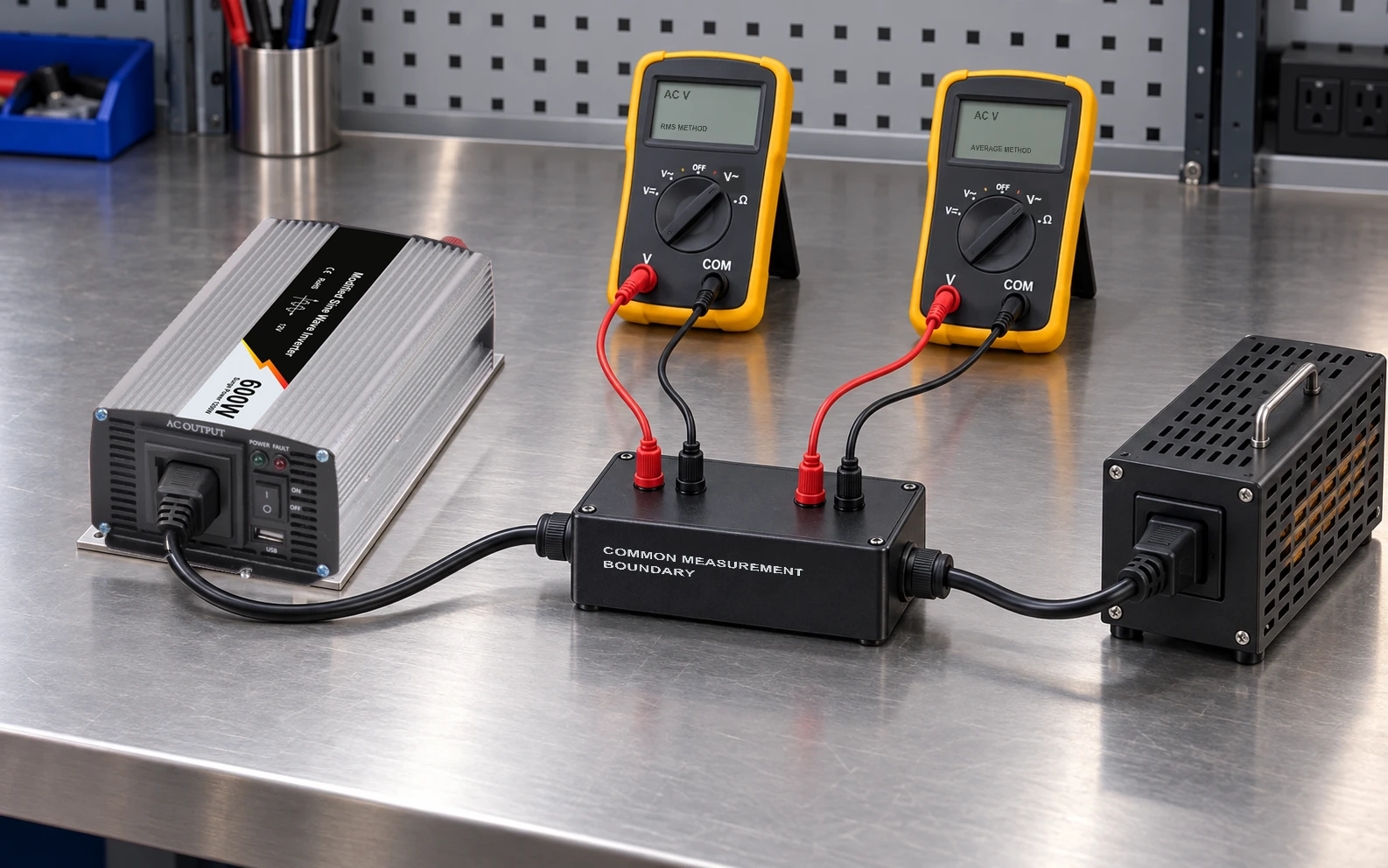
Use a voltage-measurement method whose waveform, bandwidth and crest-factor limits cover the inverter output. An average-responding meter calibrated for a sine wave can give a misleading number on a modified-sine waveform. A true-RMS label still requires attention to the instrument’s conditions.
IL WEHO WHM-600 modified-sine inverter family provides the product reference for this measurement-method review. The result is a reproducible meter-suitability record, not a verdict that a particular unit’s voltage is correct or faulty.
Separate waveform shape from the reported RMS number
RMS describes the heating-equivalent magnitude of a waveform. An average-responding instrument uses a relationship appropriate to a sine wave to produce its displayed AC value. A different waveform can break that relationship.
Fluke’s application note explains why nonsinusoidal signals require an appropriate RMS measurement. It does not provide a correction factor for every inverter and averaging meter.
Do not multiply an unexpected reading by a number found online and call it the actual voltage. The error depends on waveform and instrument method. A visible difference between two meters is a reason to examine their specifications, not proof that one unit has failed.
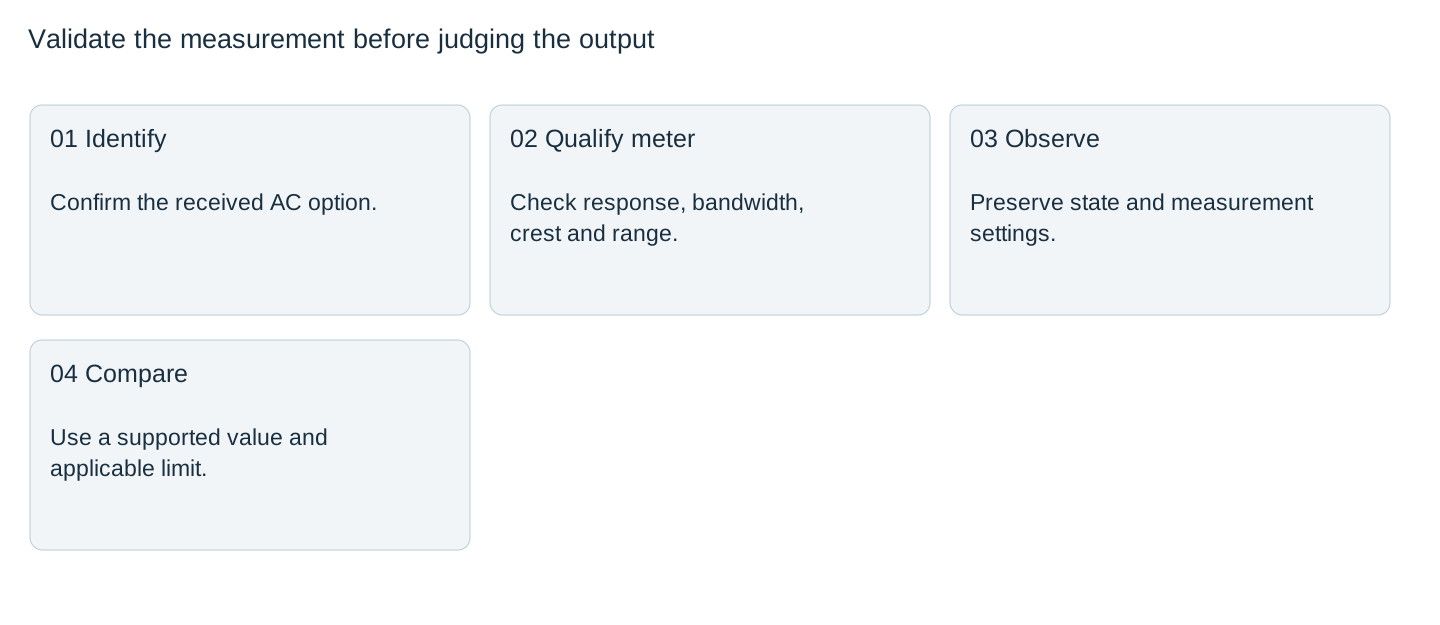
Identify the supplied output option first
The WHM-600 table identifies modified-sine output, 600 W rated power and 1200 W peak power. Its AC voltage choices are separate options. The original photograph shows the 600 W/12 V example and preserves its actual markings.
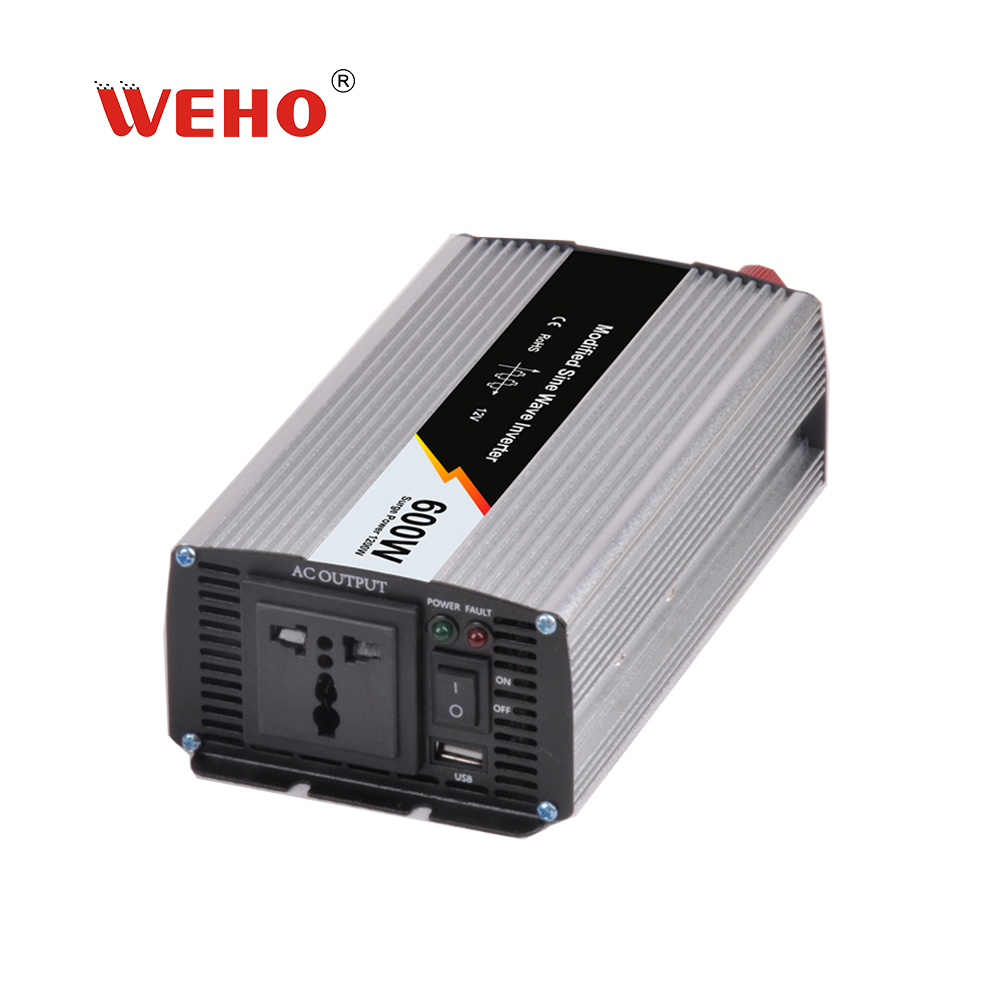
Confirm the supplied nominal AC voltage/frequency and matching tolerance from the unit documents. The socket shape cannot distinguish those options. Before comparing any meter number with a limit, make sure that limit belongs to the received configuration.
Keep the battery-input condition and load state with the observation. A no-load result and a loaded result are different conditions, even when taken with the same meter.
Read the instrument envelope, not only the front label
| Instrument item | Why it matters | Il record |
|---|---|---|
| AC response and coupling | Determines what portion/method is measured | True-RMS/average, AC-only/AC+DC mode |
| Frequency bandwidth | Affects nonsinusoidal component coverage | Specified range and selected filter |
| Crest factor and range | Peaks can exceed the instrument’s valid envelope | Range, RMS level and peak information |
| Probe/leads and rating | Defines the complete measurement arrangement | Applicable accessories and safe method |
IL Fluke 287/289 manual, for example, gives range-dependent crest-factor and nonsinusoidal accuracy conditions. Those are specifications of that instrument, not universal allowances for all true-RMS meters.

Use crest factor to expose a missing measurement condition
Current or voltage crest factor is peak divided by RMS. For a hypothetical voltage waveform with 300 V peak and 200 V RMS, crest factor is 1.5. That arithmetic alone does not establish measurement accuracy: frequency content, range, coupling and the instrument’s specified limits still matter.
If an instrument clips a peak or filters relevant components, the displayed RMS value may no longer represent the quantity intended by the test. Choose a method that covers the signal instead of widening an acceptance tolerance to include an uncertain reading.
The example values are assumed and do not describe WHM-600 output. Do not infer a product waveform plateau, duty ratio or RMS target from the drawing used to explain the method.
Repeat a defined observation before diagnosing the inverter
Use qualified personnel and a connection arrangement appropriate to the output. Retain the instrument model, range, filters, measurement location, DC input, AC load and observation interval. Do not create an unintended earth connection with a grounded measurement accessory.
If readings disagree, repeat the same state with a suitable reference method and compare settings before replacing hardware. If a waveform capture is used, keep its scales, acquisition information and processing method rather than only a cropped picture.
Only then compare the supported result with the applicable output requirement and receiver behavior. An accurate RMS voltage does not by itself approve a connected appliance’s waveform compatibility. Record that separate review rather than turning a better meter into a universal compatibility test.
Send the measurement conditions with the reading
When discussing WHM-600 output with WEHO, provide the exact AC option, input/load state, instrument and settings, and the original reading or trace. Request the matching output specification before drawing a fault conclusion.
Modified-sine voltage measurement record
| State | Meter mode/range/filter | Reported RMS / reference | Raw record / uncertainty | Specification comparison |
|---|---|---|---|---|
Blank project worksheet. Enter verified project data; example calculations above are not measurements.