Introduzione
Se sei un acquirente di Battery Charging System, Alimentazione elettrica La scelta della tensione di ricarica corretta non solo influisce sulla velocità di ricarica, ma determina anche direttamente l'efficienza di ricarica della batteria, la durata della batteria e i costi operativi complessivi.
Sia che si utilizzi una batteria agli ioni di litio, una batteria LiFePO4 o una batteria al piombo, è fondamentale conoscere i parametri di tensione corretti. Questo articolo ti aiuterà a padroneggiare rapidamente come scegliere la tensione di carica appropriata e migliorare le prestazioni di ricarica complessive.
Che cosa è Battery Charging Voltage?
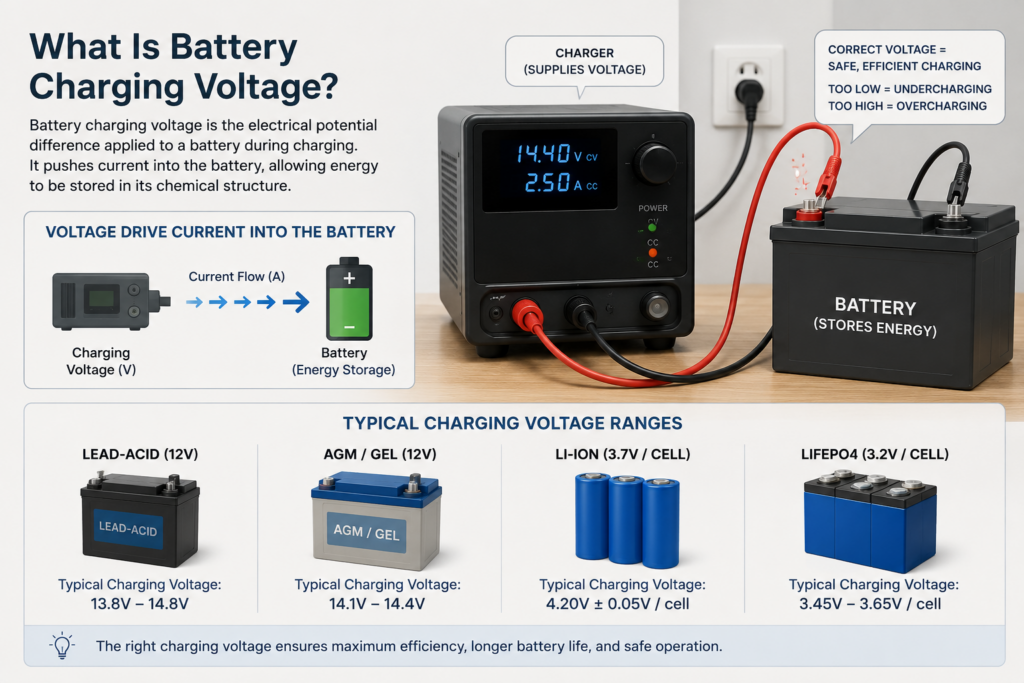
La tensione di carica della batteria si riferisce alla tensione applicata al terminale della batteria durante la ricarica.
Se la tensione è troppo bassa, la batteria non può essere piena; se la tensione è troppo alta, può causare surriscaldamento, attenuazione della capacità e persino rischi per la sicurezza.
Per gli acquirenti, la comprensione del campo di tensione di carica richiesto per le diverse batterie è la base per la scelta della batteria appropriata. Alimentazione industriale.
Perché la tensione di ricarica è importante per l'efficienza della batteria
Molti acquirenti prestano maggiore attenzione alla velocità di ricarica, ma ignorano l'impatto della tensione di ricarica sull 'efficienza.
Quando il voltaggio è ragionevole:
- Abbreviare il tempo di ricarica
- Ridurre la perdita di energia
- La temperatura della batteria si riduce.
- Estendere la durata della batteria
- Miglioramento della stabilità del sistema
I dati della ricerca mostrano che la tensione di carica errata può portare a una perdita di efficienza 10%-30% e ridurre la durata della batteria.
Per i sistemi di accumulo di energia a lungo termine, AGV, EV Charging System e Backup Power System, questa perdita si tradurrà direttamente in costi operativi più elevati.
Guida rapida: tensione di ricarica consigliata per diversi tipi di batteria
Di seguito è riportato l'intervallo di tensione di ricarica a cui gli acquirenti si riferiscono più spesso.
| Batteria di tipo | Voltaggio nominale | Consigli Charging Voltage |
| Batteria agli ioni di litio | 3.7V/Cell | 4.2V/Cell |
| Batteria di tipo LiFePO4 | 3.2V/Cell | 3.6-3.65V/Cell |
| Lead-Acid Battery | 2.0V/Cell | 2.4-2.45V/Cell |
| AGM Battery | 2.0V/Cell | 2.35-2.45V/Cell |
| Gel Battery | 2.0V/Cell | 2.3-2.4V/Cell |
Batterie agli ioni di litio
If you purchase a Lithium-Ion Battery Pack, the standard charging termination voltage is usually 4.2V/Cell.
Although increasing the voltage can increase the capacity utilization rate, exceeding the recommended value will significantly accelerate aging.
Batterie LiFePO4
LiFePO4 Battery is becoming more and more popular in industrial applications.
The recommended charging voltage is generally 3.6V-3.65V/Cell. This chemical system has higher safety and longer cycle life, which is very suitable for Energy Storage System and Industrial Equipment.
Batterie di piombo-acido
Traditional Lead-Acid Battery is still widely used in UPS, communication equipment and backup power supply systems.
It is recommended to keep the charging voltage within the range of 2.4V-2.45V/Cell to avoid vulcanization and capacity loss.
Batterie AGM e Gel
Although both belong to the VRLA Battery type, AGM and Gel batteries are more sensitive to voltage.
When purchasing, the manufacturer’s recommended parameters should be specially confirmed, otherwise it is easy to have a decrease in life.
Efficienza di carica della batteria: 7 fattori da considerare quando si sceglie la tensione di ricarica

Batteria chimica
Different Battery Chemistry have completely different requirements for charging voltage.
For example:
Lithium-Ion Battery: 4.2V/Cell
LiFePO4 Battery: 3.65V/Cell
Lead-Acid Battery: 2.45V/Cell
Therefore, the battery chemical system must be confirmed before purchasing.
Capacità della batteria
Large-capacity batteries usually require a longer charging cycle.
If you purchase a high-capacity energy storage system, you must ensure that the Power Supply can stably output the target voltage without fluctuations due to load changes.
Stato di carica (SOC)
With The Improvement Of The State Of Charge (SOC), The Ability Of The Battery To Accept The Charging Current Will Decrease.
Therefore, modern chargers usually adopt:
Constant Current Mode
Constant Voltage Mode
Combine strategies to improve efficiency.
Corrente di carica
The voltage and current must be matched.
If the current is too high, even if the voltage is correct, it may lead to:
- Excessive heat
- Reduced lifespan
- Loss of efficiency
Therefore, Charging Current and Charging Voltage should be considered at the same time when purchasing.
Temperatura operativa
Temperature has a great impact on the charging performance.
| Temperatura | Charging Performance |
| Sotto 0°C | Significant Efficiency Reduction |
| 0°C-25°C | Optimal Charging Range |
| 25°C-45°C | Good Performance |
| Superiore a 45°C | Increased Battery Stress |
In extreme environments, a power supply system that supports Temperature Compensation is particularly important.
Batteria età e salute
As the usage time increases, the internal resistance of the battery will gradually increase.
Even with the same voltage, the charging efficiency of aging batteries will be significantly reduced.
Purchasers should monitor regularly:
- Internal resistance
- Capacity Retention
- Cycle life
Power Supply Stabilità
This is the most easily ignored problem for many buyers.
Even if the battery parameters are completely correct, unstable Power Supply will still reduce efficiency.
Therefore, more and more enterprises are beginning to choose highly stable WEHO Alimentatore industriale solutions to ensure long-term stable charging performance.
Errori comuni di tensione di ricarica che riducono l'efficienza della batteria
Sovraccarico
Overcharging is one of the most common causes of battery damage.
The consequences include:
- Capacity loss
- Excessive heat
- Reduced lifespan
- Safety risks
Sottocarico
Long-term Undercharging will also affect the performance.
For Lead-Acid Battery, undercharge will lead to vulcanization, thus reducing capacity.
Ignorare la compensazione della temperatura
Many systems use fixed voltage charging.
However, temperature changes will change the optimal charging parameters, so the lack of Temperature Compensation will reduce efficiency.
Utilizzo di un alimentatore instabile
Voltage fluctuations will lead to:
- Incomplete charging
- Increased Heat Generation
- Battery stress
Therefore, stable output is an important requirement for industrial charging systems.
In che modo gli alimentatori industriali migliorano le prestazioni di ricarica delle batterie
For buyers, the battery performance depends not only on the battery itself, but also on the power supply system.
High-quality Industrial Power Supply can provide:
- Precision Voltage Regulation
- Stable output
- Low ripple
- Multiple Protection Functions
- Long-term reliability
For example, WEHO Alimentatore industriale is widely used in:
- Energy Storage System
- EV Charging Station
- UPS system
- Automazione industriale
- Telecom Power System
Help enterprises improve the overall Battery Charging Efficiency through stable power supply.
Come scegliere la giusta tensione di ricarica per il tuo sistema di batterie
Comprendi le specifiche della tua batteria
First of all, confirm:
- Battery type
- Capacity
- Voltage rating
- Manufacturer’s Recommendations
These data determine the best charging parameters.
Match Voltage e requisiti attuali
Don’t just focus on voltage.
You also need to make sure that:
- Tensione di uscita
- Output attuale
- Charging profile
It can be matched with the battery system.
Considerare le condizioni ambientali
If the device is running in:
High temperature
Low temperature
Outdoor environment
Then priority should be given to power supply systems with temperature compensation and protection functions.
Scegli un alimentatore affidabile
For long-term industrial applications, stability is more important than simple price.
When purchasing, it is recommended to focus on evaluation:
Efficiency rating
Funzionalità di protezione
Certification Compliance
Brand Reliability
Choosing a mature brand such as WEHO can help you reduce maintenance costs and improve system reliability.
Conclusione
Choosing the right Charging Voltage is one of the key factors to improve Battery Charging Efficiency.
For buyers, in addition to understanding the battery parameters, they also need to pay attention to Power Supply Stability, environmental conditions and system matching. By choosing reliable Alimentazione industriale solutions, such as WEHO, you can get higher efficiency, longer life and lower operating costs.
Domande frequenti
What Is The Best Charging Voltage For Lithium-Ion Batteries?
The recommended charging termination voltage of the standard Lithium-Ion Battery is 4.2V/Cell.
Can Higher Charging Voltage Improve Charging Speed?
To a certain extent, it is possible, but exceeding the recommended range will damage the battery life and increase safety risks.
Why Does Temperature Affect Charging Efficiency?
Temperature will change the internal chemical reaction rate of the battery, thus affecting the charging acceptance capacity and efficiency.
How Important Is Power Supply Stability?
It is very important. Stable Power Supply can improve charging efficiency and reduce battery aging.
Which Power Supply Is Suitable For Industrial Battery Charging?
It is recommended to choose WEHO Industrial Power Supply with high stability, low ripple and multiple protection functions.