<tdrowspan=”5″>input<tdcolspan=”3″>170~264VAC 47~63Hz, 235~373VDC<tdcolspan=”3″>0.65A/230VAC<tdcolspan=”3″>Cold start current 30A/230VAC<tdcolspan=”3″ >-10℃~+60℃; 20%~90%RH (please refer to reduce the specified number load curve)<tdcolspan=”3″ >Accord with EN55022, CLASSA<tdcolspan=”4″>1. All the parameters in has not specified, all is in 230V voltage input, AC rated load and 25 ℃ conditions measuring income value.
| Model | MS-50-5 | MS-50-12 | MS-50-24 |
| Output | DC Output Voltage | 5V | 12V | 24V |
| Output Voltage Tolerance | ±1% | ±1% | ±1% |
| Rated Output Current | 10A | 4.2A | 2.1A |
| Output Current Range | 0~10A | 0~4.2A | 0~2.1A |
| Output Power | 50W | 50W | 50W |
| Ripple And The Noise | 80mVp-p | 120mVp-p | 120mVp-p |
| DC Voltage Adjustable Scope | ±10% | ±10% | ±10% |
| Start, Rise, Keep Time | 800ms, 20ms, 24ms/230VAC. |
| Input | Input Voltage Range | 170~264VAC 47~63Hz,235~373VDC |
| Exchange Input Current | 0.65A/230VAC |
| Efficiency | 80% | 82% | 84% |
| Impulse Current | Cold start current 30A/230VAC |
| Leakage Current | <1mA/240VAC |
| Protection Characteristics | Overload Protection | Protection way: hiccups mode, load abnormal conditions can be removed recovery |
| Environment | Working Temperature, Humidity | Accord with EN55022,CLASSA |
| Keep Temperature, Humidity | -20℃~+85℃; 10%~95%RH No condensation |
| Vibrate Resistance | 10~500Hz, 2G 10min./1 cycle time, 60 minutes, the axis |
| Security | Compression Sex | Input/output: 1.5 KVAC input and between to KVAC output and the earth: 1.5: 0.5KVAC |
| Insulation Resistance | Between the input and output, the output and input: with ground: 100M Ohms/500VDC |
| Complies With The Standards | Safety Standards | Meet the UL1012 requirements |
| EMC Standard | Accord with EN55022,CLASSA |
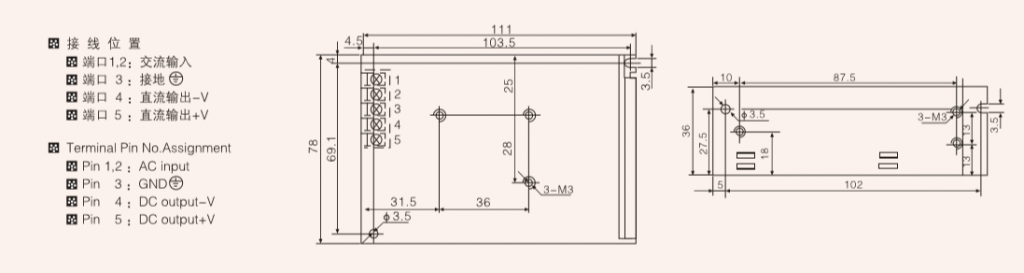
| Other | Weight | 0.26kg 111*78*36(L*W*H) |
| Packaging | 0.26kg/50pcs/14kg/0.9CUFT |
| Note |
| 2. Ripple and noise voltage is in 2 0 M H z bandwidth with 1 to 2 inches oscilloscope twisted pair end and 0. 1 mu and 4 7 muon capacitance measurement when. |
| 3. Tolerance is voltage setting error, the voltage adjustment rate and adjust the sum total of the current rate. |
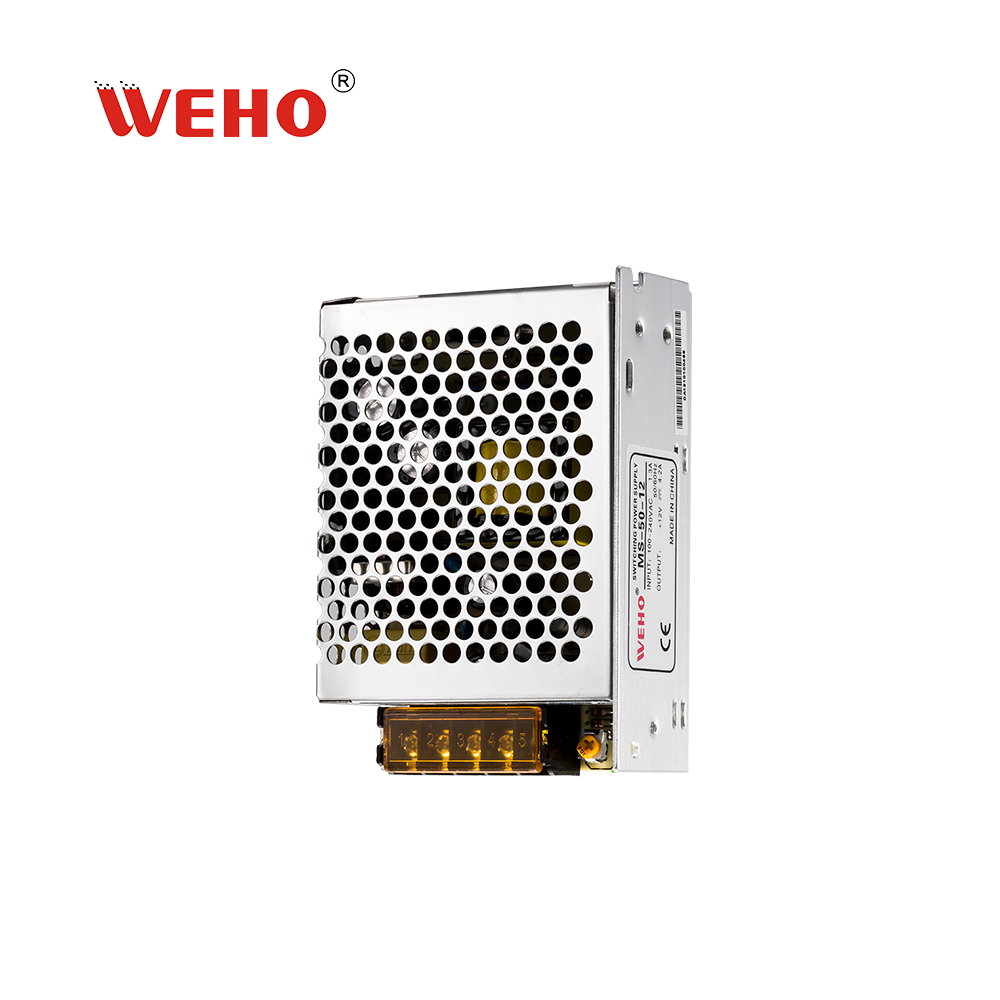
The white cap on the connector is for safety precautions against electric shock and dust protection
We make transformers and power inductors with pure coppers all by ourselves,
Weho stocks 150,000 sets of commonly used models, ensuring quick delivery.
This product has a universal AC input that is full range (up to 264VAC).
The product has completed the 100% full load aging test.
This product is covered by a 3-year warranty.
Product size: 111*78*36mm (L * W * H)
FAQs
Q1: How do I choose the right 12V 50W switching power supply?
First confirm that the equipment requires a 12V DC input. A 50W 12V power supply can theoretically provide about 4.17A at full rated output. The connected load should remain below the rated capacity, and additional power margin is recommended for continuous operation.
Q2: What devices can a 50W 12V switching power supply power?
A 50W 12V switching power supply can be used for LED systems, electronic equipment, control devices, small automation systems, and other 12V DC loads. The total power consumption of all connected devices must remain within the power supply’s rated capacity.
Q3: How much load can a 12V 50W power supply support?
At 12V output, a 50W power supply provides a maximum theoretical current of approximately 4.17A. In practical applications, the actual usable load should consider startup current, operating temperature, ventilation, and continuous working time.
Q4: How do I troubleshoot a 12V switching power supply that has no output?
Check the AC input voltage, input wiring, output polarity, terminal connections, and connected load first. Disconnect the load and test the DC output separately. If the output returns after removing the load, the system may have an overload, short circuit, or incorrect wiring condition.
Q5: When should I choose a higher-wattage 12V power supply?
Choose a higher-wattage model if the total load is close to 50W, if the equipment has high startup current, or if additional devices may be added later. Leaving sufficient capacity helps improve system stability and reduces the risk of overload during long-term operation.