Qualify a WEHO NDR-120-24 sample against its own current documents, the actual 24 V branch and the cabinet operating conditions. A catalog output rating establishes a starting point; it is not a record of your sample’s temperature rise, load-step behavior or installation acceptance.
This checklist is for an OEM purchasing or engineering team evaluating that WEHO model. It does not establish interchangeability with another manufacturer’s equipment. No specimen has been tested for this article, and the calculation below is hypothetical.
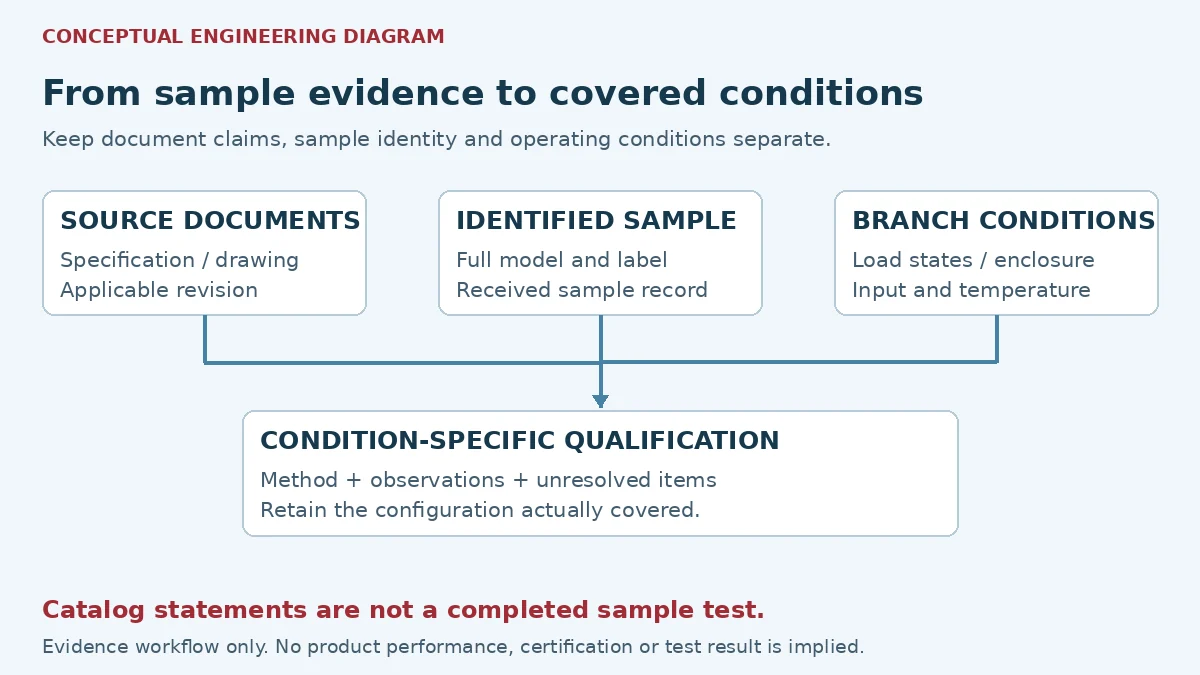
Start with the document and the actual sample
The WEHO NDR-120 family PDF, page 1, lists NDR-120-24 as 24 V with an output-current range of 0–5 A. Its input specification is 85–264 VAC or 120–370 VDC. Those are catalog statements for the listed family and suffix, not values measured on an incoming unit.
Record the complete model, nameplate, sample identifier, supplier document filename and available revision. Ask WEHO to confirm which installation instructions and drawing apply to the delivered sample. Keep the received file with the qualification record rather than assuming an unchanged filename identifies an unchanged revision.
If the delivered label, drawing, quotation or current specification differs, log the discrepancy and resolve it before using the affected value. Do not combine one source’s input marking with another revision’s thermal allowance to create a specification that neither document supports.
The same PDF prints dimensions of 40 × 125.2 × 113.5 mm. Confirm the dimension axes and the installed envelope on the applicable drawing. The catalog dimensions alone do not include a demonstrated wire-bending envelope, service access or the cabinet’s required spacing.
Define the 24 V branch before choosing the test
List the loads supplied by this branch, their permitted voltage ranges and their operating states. Separate steady demand from a relay, actuator or other load’s starting event. Identify what the controller must continue doing during each event; a lit power indicator is not a functional acceptance criterion.
For a hypothetical branch consuming 72 W at an assumed constant 24 V, the current is 72 ÷ 24 = 3 A. That is below the PDF’s 5 A catalog figure, but it does not prove satisfactory startup, transient response or thermal operation. If another defined operating state demands 132 W at that same assumed voltage, its calculated current is 5.5 A and exceeds that catalog figure.
These examples describe demand, not measured NDR performance. Real loads may behave differently during voltage dips or startup. Do not approve the branch by multiplying a nameplate wattage by a universal loading percentage, and do not treat overload protection as additional usable output capacity.
Include cable drop, branch protection and the receiver’s voltage limits in the system review. A source-terminal voltage does not establish the voltage available at the most distant load. Define the relevant observation points and permitted operating states before commissioning.
Qualify the installed thermal condition
The archived family PDF lists a working-temperature range of −10°C to +50°C. This statement is not a temperature-rise test for your enclosure and does not by itself demonstrate that the full catalog output is available at every installation condition. Obtain the applicable derating information and installation requirements for the exact sample.
Describe the cabinet ambient measurement location, ventilation, mounting orientation, neighboring heat sources and intended operating duty. Record the enclosure state used for the evaluation. A short check in an open cabinet does not cover a closed cabinet with different airflow.
Set the acceptance conditions with the responsible engineer using the applicable product documentation and system requirements. Retain the load, input and environmental conditions alongside the observations. If the proposed condition is not supported by the available documents, leave it open for engineering confirmation rather than inventing a temperature allowance.
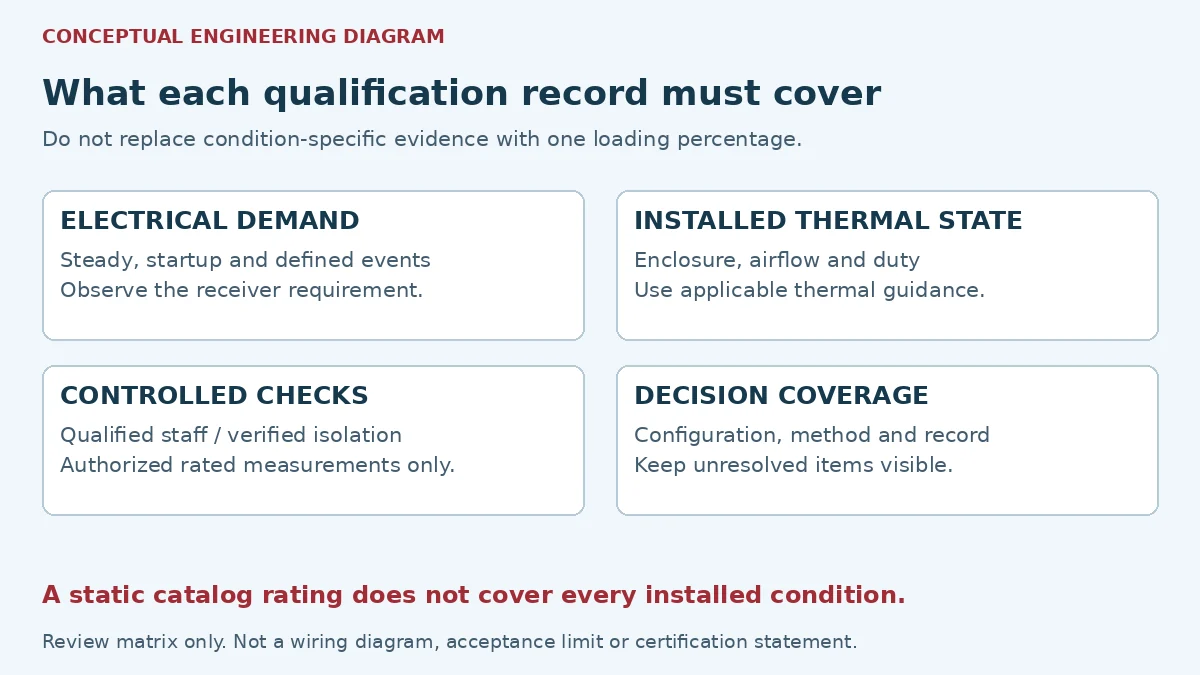
Plan controlled checks without improvising wiring
Qualified electrical personnel should work to the applicable installation and commissioning procedure. Isolate and verify all relevant energy sources before making or changing connections. Any separately authorized energized measurement requires suitable rated equipment and a defined safe method; this article supplies no terminal-by-terminal wiring instruction.
Confirm the actual input arrangement, protective-earth requirements, conductor preparation, terminal identification and protection from the model-specific instructions. Request missing torque or installation information instead of importing a value from another power supply that looks similar.
For the output review, keep the final load disconnected until the procedure’s initial checks permit connection. Return to verified isolation before attaching or changing the load. Apply the controlled commissioning procedure for the defined operating states, and stop if the documented limits or safeguards cannot be maintained.
Keep a condition-specific qualification record
| Record | Evidence to retain | What remains unproven without it |
|---|---|---|
| Sample identity | Complete suffix, nameplate and sample identifier | That the evaluated unit matches the supplied model |
| Source documents | Applicable PDF, drawing and installation revision | Which instructions govern the sample |
| Branch demand | Steady, startup and defined event conditions | Operation beyond one static load point |
| Installed temperature | Enclosure, ambient location, airflow and duty | Thermal operation in another cabinet state |
| Observed function | Method, instrument details, load response and raw record | Receiver continuity or regulation under untested conditions |
| Decision | Covered configuration, reviewer and unresolved items | Release of an unreviewed configuration or later revision |
Separate a missing document from a failed check. Both can prevent release, but they require different next steps. An accepted result should name the configuration and conditions actually covered. Revisit the affected checks after a change to the supply revision, load, enclosure or installation.
For a distinct mechanical review of the smaller model, see the WEHO NDR-75-24 installation-fit checklist. Its dimensions and conclusions are not specifications for NDR-120-24.
Frequently Asked Questions
Does 24 V and 5 A prove the sample can supply my cabinet?
No. Those catalog values do not cover the branch’s starting events, receiver voltage limits or the cabinet’s thermal conditions. Evaluate the exact sample and defined operating states.
Has WEHO tested a sample for this article?
No sample test is reported here. The product values come from the linked family PDF; the 72 W and 132 W examples are hypothetical calculations.
Is one loading percentage enough for qualification?
No. A fixed percentage cannot establish startup capability, applicable thermal derating or voltage at the load. Document those requirements separately.
What if the received label differs from the PDF?
Resolve the affected discrepancy with WEHO before relying on that value. Retain both sources and the clarification with the identified sample.
Must the review be repeated after a design change?
Repeat the checks affected by the change. Preserve the original coverage so that an earlier result is not silently extended to a different supply, load or enclosure.
Request documents for the actual sample
Send the full WEHO model, sample label, branch demand, cabinet conditions and unresolved document items. Ask for the applicable specification, installation drawing and thermal guidance before completing your qualification record.