Last Updated: October 3, 2026
Quick Answer: A switching power supply aging test can support manufacturing screening and purchasing acceptance when its purpose, limits, sample identity and records are agreed before energisation. It does not, by itself, establish service life, certification or suitability for an entire machine. For the WEHO NDR-120-24 example, use the controlled ordered specification, identify the exact 24 V, 5 A model, and preserve a traceable record of the actual test configuration and disposition.
Define what the test is intended to establish
The term “aging test” is often used for several different activities: production screening, an incoming inspection run, a system qualification exercise or an accelerated reliability investigation. Those activities answer different questions. A buyer should specify which decision the report will support rather than ask only whether a unit has been “aged.”
For a production lot, the useful output is a documented screening result for identified units under an agreed procedure. An OEM pilot-lot review may instead investigate behaviour in a particular controller enclosure. Neither result automatically predicts years of field service. A formal accelerated-life investigation needs a justified stress model and analysis; ordinary burn-in records should not be relabelled as that evidence.
Bind the exact model and revision to the lot
Before defining electrical conditions, capture the purchase order, supplier, full model, unit or sample identifiers, lot reference and controlled specification revision. Keep the identification record connected to the eventual test file. If a serial number or lot marking is absent, obtain the supplier’s agreed identification method; do not invent a traceability code and present it as a factory marking.
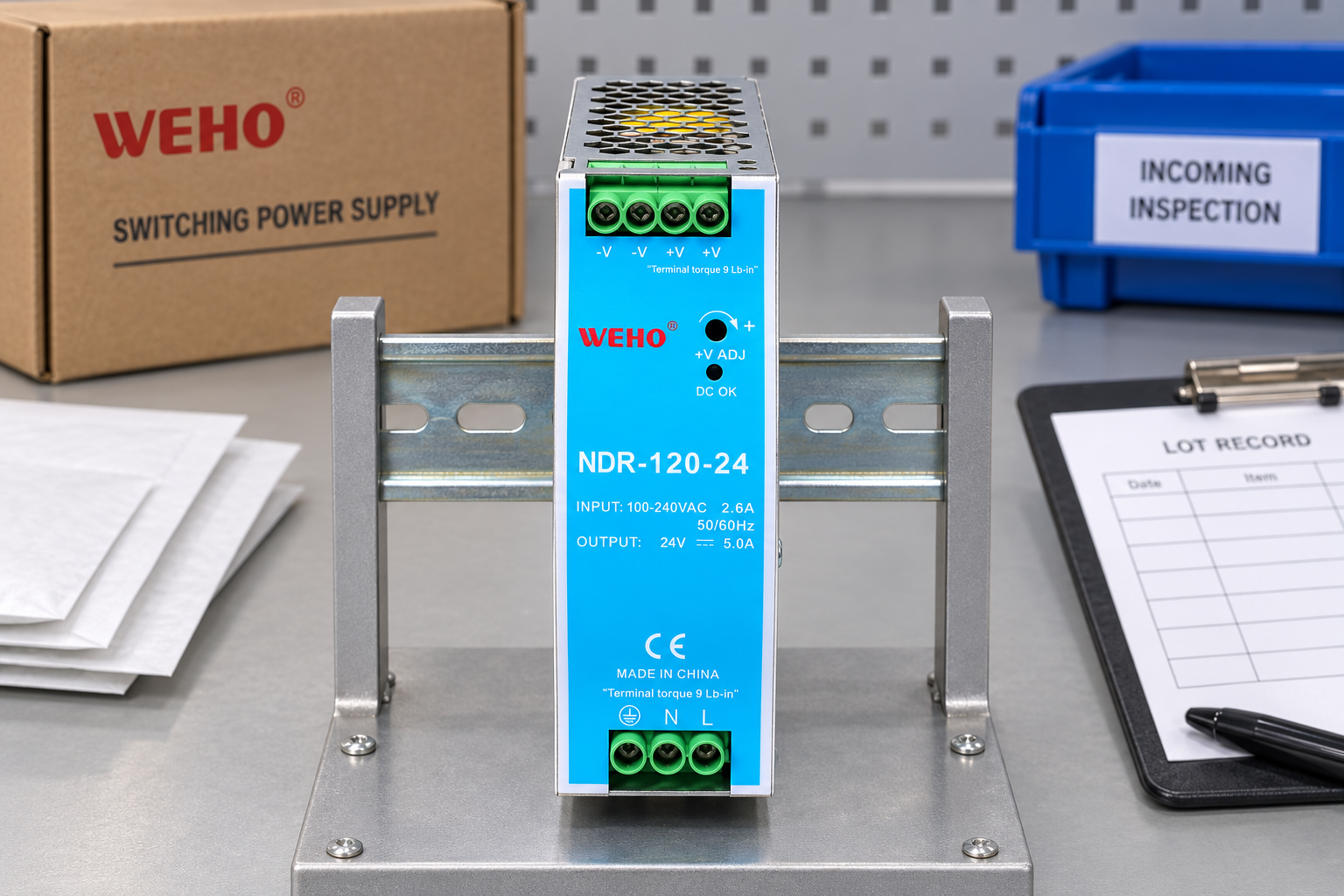
The WEHO NDR-120 family page and current specification identify the NDR-120-24 example as 24 V, 5 A, or 120 W. Its mechanical envelope is 40 mm wide along the rail, 125.2 mm upright and 113.5 mm front to back. The rear rail support and outward-facing blue label must not be reversed during assembly.
The source photograph prints nominal input “100–240 VAC,” 2.6 A and 50/60 Hz; the current specification table separately states an 85–264 VAC operating range and 47–63 Hz. Confirm the ordered revision and intended input with WEHO before release. Do not silently replace the physical label or rely on inconsistent website input-table text.
Agree criteria before collecting measurements
A switching power supply aging test plan should name the responsible qualified person, its screening or qualification purpose, selected units, input conditions, load profile, enclosure configuration, monitoring points and acceptance limits. It also needs a defined response to abnormal behaviour. Agree those items before testing so that a disappointing result cannot be converted into a pass by changing the criteria afterward.
Use the applicable manufacturer instructions and the approved product or system requirements. This article supplies no universal test duration, chamber temperature, cycling period or overload setting. A rated output is not permission to exceed the allowed input, temperature, load or mounting conditions. Testing outside normal ratings requires a separate justified procedure and supplier agreement, not a generic purchasing checklist.
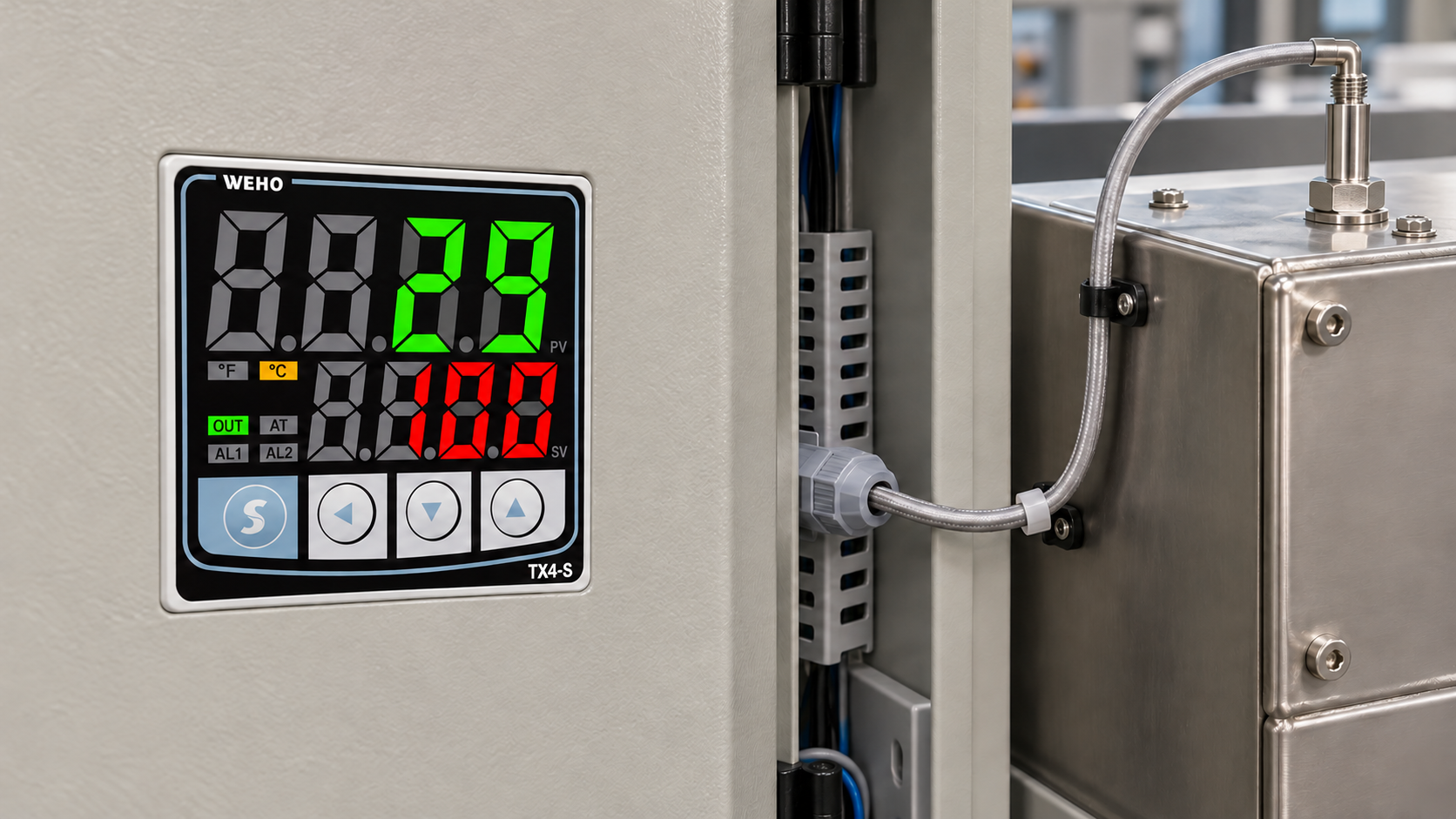
Identify the measurement method as well as the limit. Output voltage at the supply terminals and voltage at a remote controller are different observations. Instrument identity, relevant calibration status, connection arrangement and measurement uncertainty belong in the record where they affect the decision. Do not treat an LED colour or a photograph of an instrument as a complete acceptance report.
Separate component screening from system qualification
A power supply can be screened as a component without proving the final cabinet. Cabinet temperature, neighbouring heat sources, airflow obstruction, conductor losses and auxiliary-load behaviour can change the operating conditions. A test record should therefore state whether it represents an isolated fixture or a particular released assembly configuration.
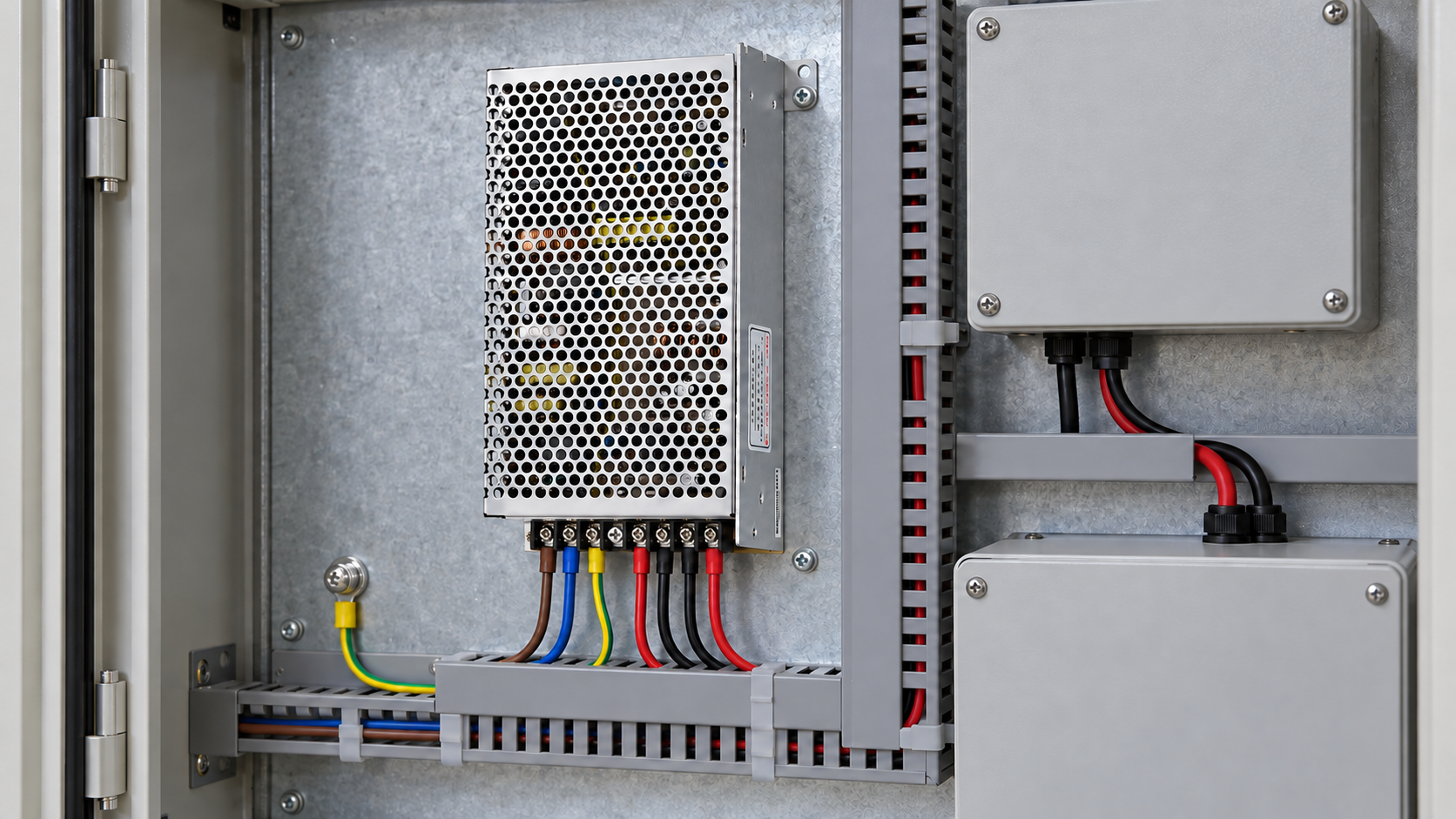
For an HVAC-controller OEM pilot lot, the NDR example concerns documented 24 V auxiliary electronics, not compressor or heater power. Freeze the controller enclosure and load definition before an electrical qualification. The image below shows isolated mechanical preparation only: empty power-supply terminals are not evidence of a live building controller or a successful test.

Similarly, a horticulture lighting-controller sample can involve auxiliary electronics rather than the lighting arrays themselves. Do not infer LED-array compatibility, lighting output or a finished greenhouse installation from a 24 V control-power example. Preserve the distinction between a preparation illustration and the measured configuration identified in a real qualification file.

Record observations and control abnormal results
During an authorised switching power supply aging test, record the actual conditions and observations using the approved method. Preserve raw files where relevant, with timestamps or sequence references that make the test understandable. Record changes to the load, input, enclosure or measurement arrangement rather than allowing them to become invisible differences between samples.
If behaviour falls outside the agreed criteria, follow the approved safe stop and isolation procedure, identify the affected sample and retain the evidence. A qualified responsible person should decide the investigation and disposition. Do not repeatedly restart a suspect unit until it appears normal, discard earlier abnormal records or continue an unsafe test to reach a promised duration.
Protection operation is also not automatically a pass or a failed component. Compare the actual conditions and observed response with the applicable requirements. Internal power-supply protection does not replace required upstream circuit protection, safe test-fixture construction or installation rules. Qualification and fault investigations belong to competent personnel with the correct controlled instructions.
Make the report usable for procurement and change control
The report should connect the exact lot and samples to the procedure revision, approved criteria, configuration, instruments, observations, deviations and authorised disposition. Keep “not tested,” “not applicable” and “awaiting decision” separate from “accepted.” A blank checklist is a plan, not evidence that the checks occurred.
For repeat orders, retain the supplier’s declared product revision and agreed notification process. A change of model, relevant construction, firmware in the supplied system, enclosure layout or load arrangement may require reassessment. Decide the scope from the change and approved requirements instead of assuming that an old result transfers indefinitely.

Questions to resolve with the supplier
Ask what its supplied aging-test report actually represents: which models and units, which procedure revision, which conditions, and who authorised the release. Ask how deviations are retained and linked to the lot. Request additional evidence when the intended end use requires it; a generic screening statement is not a substitute for an application-specific qualification or certification document.
For the exact WEHO example, request the controlled NDR-120 specification and installation instructions for the ordered revision. Use the WEHO contact channel to agree the documentation scope. This article and its images contain no factory test results, approved acceptance thresholds or lifespan guarantee.
Key Takeaways
- Define whether the activity is lot screening, incoming acceptance or system qualification.
- Bind the full model, ordered revision and sample identifiers to the records.
- Agree operating limits and acceptance criteria before collecting observations.
- Keep component results separate from final-cabinet and end-use claims.
- Preserve deviations and controlled disposition; never fabricate a pass or infer service life from ordinary screening.
Conclusion
A switching power supply aging test is useful when it produces an auditable decision, not simply an impressive duration or photograph. For NDR-120-24 procurement, confirm the exact ordered documentation, keep testing within the approved procedure and retain lot-linked evidence. That provides a practical basis for acceptance and follow-up while respecting what the available records do—and do not—demonstrate.
Frequently Asked Questions
What does a switching power supply aging test establish?
It can establish a recorded screening or acceptance outcome for identified samples under an agreed procedure. Its scope must distinguish production screening, incoming inspection and system qualification. It does not automatically establish lifespan or suitability for an entire machine.
Does passing burn-in guarantee years of service life?
No. Ordinary burn-in or screening records do not by themselves predict service life. A formal life estimate requires appropriate reliability evidence and analysis; do not convert a screening pass into a lifespan guarantee.
How long should the aging test run?
There is no universal duration supplied by this guide. The responsible qualified team and supplier should agree the purpose, procedure, permitted conditions and acceptance criteria for the exact ordered revision before execution.
Can a buyer test above rated load or temperature?
A general checklist is not permission to exceed ratings. Testing outside normal product limits requires a separately justified and authorised procedure with supplier agreement, appropriate equipment and competent personnel.
Which records support lot traceability?
Connect the purchase order, full model, controlled revision, lot and sample identifiers to the procedure, criteria, test configuration, instruments, actual observations, deviations and authorised disposition. A blank checklist or illustration is not a completed test record.
Is component screening sufficient for the final cabinet?
Not necessarily. Enclosure conditions, nearby heat sources, airflow, conductor losses and the actual auxiliary load can differ from an isolated fixture. State the tested configuration and reassess relevant changes against approved requirements.
Why does the NDR-120-24 example show different input ranges in its label and specification?
The source label prints nominal100–240VAC2.6A50/60Hz; the current specification table lists85–264VAC47–63Hz operating input separately. Preserve that distinction and confirm the controlled ordered revision with WEHO before electrical acceptance. Neither source is a real test result.